
Florence, 3 May 1469 – 21 June 1527
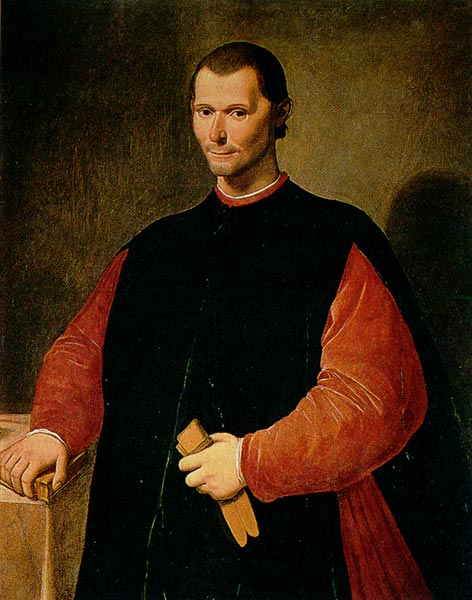
Niccolò Machiavelli portrait painted by Santi di Tito
Niccolò di Bernardo dei Machiavelli – known as Niccolò Machiavelli – born in Florence in 1469 to an ancient but decayed family, since his adolescence was familiar with the Latin classics. He began his career working for the government of the Florentine Republic at the fall of Girolamo Savonarola. With the election of Gonfalonier Pier Soderini, he first became Secretary of the second chancellery and later Secretary of the Council of Ten. He carried out delicate diplomatic missions to the court of France (1504, 1510 -11), the Holy See (1506) and the imperial court of Germany (1507-1508), which helped him in developing his strategic thinking; in addition, he held official communications between central government bodies and ambassadors and army officials engaged at foreign courts or in Florentine territory.
As noted by the great 19th century literary historian Francesco De Sanctis, Machiavelli with his political science theorised the emancipation of man from the influences of the supernatural and fantastic elements created by the powerful, not only because to the concept of a superior providence (or Fortune) that influence human affairs, he places side by side the concept of man as the creator of history (thanks to the power of his spirit and intelligence), but above all because the concept of obedience to the “auctoritates”, which predispose and order everything (as well as, of course, legislate), is replaced by an approach that takes into account the observation of reality in its “effected truth”, as defined by his scientific and philosophic approach to politics. Going down to the reality of praxis, therefore, he suggests that instead of so-called “morality”, a set of abstract rules that are often and willingly disregarded by individuals, the rules of everyday political practice should be substituted, which have nothing to do with morality, even less with religious morality. And it must be borne in mind that when Machiavelli wrote, morality was identified almost exclusively with religious morality, as the idea of a secular morality was still a long way off.
With regards to the institutional reflection, Machiavelli takes further steps forward with respect to the logic of his time, thanks to the fact that he replaces the concept of Feud with the modern and broader concept of State, which, as he emphasises several times in his writings, must be rigorously separated from religious power. In fact, a State worthy of the name and wishing to act consistently with the new logic set by the Florentine, could not subordinate its action to rules imposed by an authority that descends on it “from above”, so to speak. Quite audaciously, Machiavelli goes so far as to say, albeit in a still immature and embryonic way, that it is instead the Church that must be subordinated to the State.
It is important to emphasize that Machiavelli’s reflections always draw their “humus” and their “raison d’être” from a realistic analysis of the facts, as they present themselves to a dispassionate and unprejudiced biases.
In any case, it was precisely his diplomatic missions in Italy that gave him the opportunity to get to know some of the princes and to observe closely their differences in government and political direction; in particular, he got to know and work for Cesare Borgia and on this occasion showed interest in the political astuteness and iron fist displayed by the tyrant (who had recently established a personal dominion centred on Urbino). Precisely from this, he would later in most of his writings draw very realistic political analyses of the contemporary situation, comparing it with examples from history (especially Roman history).

Statue of Machiavelli Galleria degli Uffizi a Firenze.
For instance, in his most famous political treatise, “The Prince” (written in the years 1513-14, but not published in print until 1532), he analyses the various kinds of principalities and armies, attempting to outline the qualities necessary for a prince to conquer and preserve a state, and to gain the respectful support of his subjects. Using his valuable experience, he sketches the figure of the ideal ruler, able to rule a strong State and successfully deal with both external attacks and the uprisings of his subjugates citizens, without being too constrained by moral considerations but only by realistic political assessments. For instance, if the “actual reality of the thing” presents itself as violent and dominated by struggle, the prince will have to impose himself by the use of force. Famous is its quote: “It is better to be feared than loved, if you cannot be both,” The writer was also able to apply himself as a politician, unfortunately not with great luck. Already in 1500, when he was at the court of Cesare Borgia, he realised during a military encampment that foreign mercenaries were weaker than Italian ones. He then organised a popular militia with which to ensure the patriotic defence of the common good of the Republic of Florence (he was in charge of organising the military defence of Florence from 1503 to 1506). However, that militia failed in its first action in 1512 against the Spanish infantry in Prato, and thus the fate of the Republic and Machiavelli’s career was comprimised. After the end of the Republic of Florence, the Medici regained power over Florence with the help of the Spanish and the Holy See, and Machiavelli was dismissed.
In 1513, after a failed plot, he was unjustly arrested and tortured. Shortly after the election of Pope Leo X (of the Medici family), he was finally granted his freedom. He then retired to Sant’Andrea, to his estate. In that sort of exile, he wrote his most important works. Afterwards, despite his attempts to win the favour of his new rulers, he was unable to obtain a position in the new government similar to his past one. He died on 21 June1527.
Even today, however, when people speak of “Machiavellianism” they mean, not quite rightly, a political tactic that seeks, without respect for morality, to magnify one’s own power and wealth, hence the famous motto (which Machiavelli apparently never uttered), “The end justifies the means”. A paraphrase of Niccolò Machiavelli that means that if a goal is morally important, any method of getting it is acceptable.
“An apostle repudiated by the men of his time”, Niccolò Machiavelli was not only “the greatest political thinker after Aristotle”, he was also a humble servant of his city and a shrewd observer of world affairs, in an Italy ridden with rivalry and turmoil, governed by corrupted feudal lords ready to sell themselfs to the highest bidder, in order to maintain their power and privileges.
References: biografieonline – Wikipedia
